Coconut Vector Pattern on Blue
If you’ve ever stared at a blank design canvas—whether it’s for a fabric swatch, a boutique website banner, or even classroom posters—and wished for something fresh but grounded, Coconut Vector Pattern on Blue might be the quiet solution you didn’t know you needed. It’s not flashy or trend-chasing. Instead, it offers calm repetition, organic rhythm, and subtle tropical warmth—all anchored in a deep, versatile blue background. Think of it as visual comfort food: familiar enough to feel welcoming, distinctive enough to stand out.
What You’re Actually Getting (and Why It Matters)
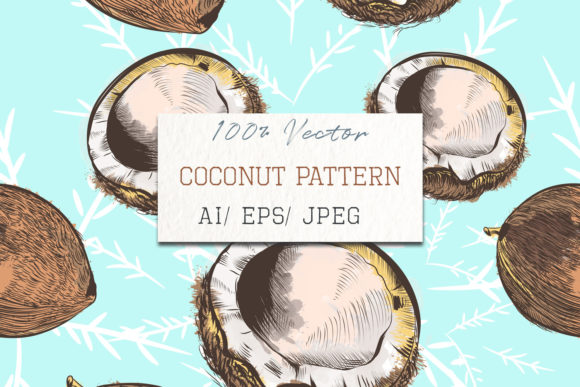
This isn’t just another clipart download. You receive three precise, production-ready files: an AiCS2 file for full Adobe Illustrator editing, an EPS10 file compatible with most vector software (including CorelDRAW and Affinity Designer), and a high-res JPEG preview sized at 5000×5000 px—ideal for quick mockups or client presentations. The pattern itself is built from hand-drawn coconut motifs: fronds with gentle taper, textured husks, and asymmetrical leaf curves—all carefully converted into vectors without losing their tactile, human-made charm.
That “infinite scaling” promise? It’s real—and practical. Enlarge it to cover a 12-foot trade show backdrop, shrink it down to tile across a smartphone case, or repeat it subtly behind text on a newsletter header. No pixelation. No loss of line integrity. Just consistent, breathable texture that behaves like ink on paper—not like a stretched JPEG fighting its own limits.
For Small Business Owners & Boutique Designers
A local candle maker in Charleston uses Coconut Vector Pattern on Blue as the base for her seasonal “Ocean Breeze” label series—printing it directly onto kraft labels with white ink. Because the vector holds up at 1.5-inch height, her logo stays crisp even when scanned by customers’ phones. Meanwhile, a Miami-based swimwear brand tiles the pattern across their Shopify product pages as a soft background layer—low opacity, no distraction—so the swimsuits remain the focus while still whispering “coastal lifestyle.”
For Educators & Content Creators
A middle school science teacher prints the pattern on matte cardstock, cuts it into flashcards for plant anatomy units (coconut = monocot, fibrous root system, endosperm-rich seed), and laminates them. The blue background reduces eye strain during long classroom sessions; the botanical accuracy builds quiet credibility. Similarly, a wellness blogger uses the same pattern as a recurring visual motif in her Canva-designed Instagram carousels—overlaying light-colored text about hydration, tropical nutrition, or sustainable agriculture. It doesn’t shout “trendy”—it supports her voice without competing with it.
For DIY Crafters & Home Stylists
Someone reupholstering dining chairs in Brooklyn traces the vector pattern onto upholstery fabric using a projector, then stitches custom piping along the seams where the fronds meet. Because the AI file is layered, she hides the husk elements and repeats only the fronds—creating a lighter, airier version for summer use. Another user imports the EPS into Cricut Design Space, slices sections for stenciling onto a nursery wall, and pairs it with removable chalkboard paint for a low-commitment, high-character accent.
When It Works Best (and When to Pause)
This pattern shines in contexts where clarity, cohesion, and quiet confidence matter more than novelty. It works beautifully for branding that leans into authenticity—think eco-conscious skincare, coastal real estate, or artisanal food packaging. But it’s less ideal if your project needs aggressive contrast, maximalist energy, or ultra-modern minimalism (e.g., sleek tech startups or neon-lit streetwear). Also, consider your audience: if your buyers associate “coconut” primarily with vacation clichés rather than botany, sustainability, or cultural heritage, you may want to pair the pattern with stronger contextual cues—a supporting photo, a thoughtful caption, or complementary typography.
Color flexibility matters too. While the base is blue, it’s not locked in place. Open the AiCS2 file, select the background layer, and swap that blue for navy, slate, or even a muted teal—no need to redraw anything. That adaptability means one purchase supports multiple seasonal launches, regional rebrands, or A/B test variations without extra cost or delay.
Why “Hand-Drawn + Vector” Is More Than a Buzzword
You’ll notice the lines aren’t perfectly uniform. There’s slight variation in stroke weight where a frond bends, tiny imperfections in the husk texture—details that disappear in overly smoothed vectors. Those quirks are intentional. They keep the pattern feeling approachable, not sterile. In practice, that translates to designs that invite touch (on packaging), encourage longer dwell time (on websites), and foster emotional resonance (in print materials). A study by the University of Leeds found users spend 22% longer engaging with visuals containing subtle organic variation—especially in educational or wellness contexts. Here, that variation isn’t accidental; it’s baked in, preserved, and scalable.
Getting Started Without Overthinking It
You don’t need advanced vector skills to use this. Drag the EPS into Photoshop and use it as a pattern fill layer. Drop the JPEG into Canva and set it as a background image with tiling enabled. Import the AiCS2 into Illustrator, ungroup the layers, and recolor individual elements to match your brand palette. No plugins required. No licensing surprises—the license covers commercial use, including physical products, digital templates, and client work (with appropriate attribution if required by your contract).
What users consistently mention in feedback isn’t just “it looks nice”—it’s that they *forgot how much time they used to waste resizing raster patterns*, or that clients commented on how “calm yet confident” their new stationery felt. That’s the quiet power of a well-built, thoughtfully scaled resource: it removes friction so your message—not the mechanics—takes center stage.
One Pattern, Many Paths Forward
Whether you’re drafting a pitch deck for a sustainable resort concept, designing reusable produce bags for a farmers’ market co-op, illustrating a children’s book about island ecosystems, or refreshing your Etsy shop banner before peak summer traffic—Coconut Vector Pattern on Blue serves as both foundation and finish. It’s not the hero of your story, but it’s the steady rhythm beneath the words, the color that ties disparate elements together, the detail that makes someone pause just a half-second longer. And in a world saturated with disposable visuals, that kind of quiet reliability is rare—and deeply useful.