Colorful Tropical Fish Seamless Pattern: A Practical Guide for Designers and Makers
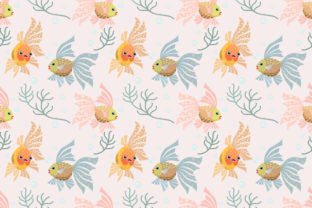
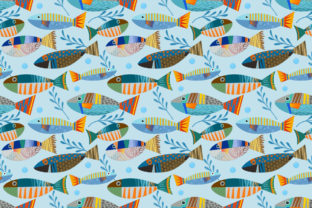
A Colorful Tropical Fish Seamless Pattern is a repeatable digital design composed of stylized, vibrant fish—often inspired by coral reef species like angelfish, parrotfish, and clownfish—arranged to tile infinitely without visible seams. Unlike standalone illustrations or photographic assets, this pattern is engineered for scalability and repetition across surfaces. Its defining traits include balanced negative space, consistent color harmony across the repeat unit, and vector- and raster-ready file delivery (EPS 8 and 5000 × 5000 px JPG). This makes it functionally distinct from clipart, single-image motifs, or non-seamless illustrations that require manual tiling or risk alignment gaps.
How It Fits Within Broader Pattern Categories
Seamless patterns fall into several broad stylistic families: geometric, botanical, abstract, animal-themed, and cultural motifs. The Colorful Tropical Fish Seamless Pattern sits at the intersection of illustrative and thematic design—more expressive than minimalist geometry, more structured and repeatable than free-form underwater illustrations. Compared to generic “ocean” or “marine life” patterns, it emphasizes fish as primary visual elements rather than secondary accents among waves or coral. That focus gives it stronger visual identity—but also narrower thematic flexibility. For example, a botanical palm-leaf pattern may suit both tropical resorts and summer apparel; the Colorful Tropical Fish Seamless Pattern leans more decisively into playful, aquatic, or child-friendly contexts.
It also differs from hand-drawn or watercolor-style fish patterns in its technical precision. Because it’s delivered in EPS 8 format, it retains full editability in vector-based tools like Adobe Illustrator and Affinity Designer—allowing users to adjust individual fish colors, scale strokes, or isolate elements without quality loss. In contrast, many marketplace patterns are offered only as high-res JPGs or PNGs, limiting customization. The inclusion of both EPS and a large-format JPG means users aren’t forced to choose between scalability and immediate usability.
Practical Strengths Across Real-World Applications
The versatility of the Colorful Tropical Fish Seamless Pattern stems from its resolution, format options, and intentional design rhythm. At 5000 × 5000 px, the JPG version supports large-scale applications—think wallpaper murals, event backdrops, or fabric yardage for upholstery—without pixelation. Meanwhile, the EPS file allows designers to resize infinitely for small-format uses like gift tags, packaging labels, or textile swatches.
Here’s how it performs in common use cases:
- Fabrics & textiles: Works well on cotton, linen, and polyester blends. The even distribution of fish avoids clustering that can cause visual heaviness on apparel—making it more balanced than dense school-of-fish motifs.
- Gift wrapping & stationery: Scales cleanly down to 300 dpi print resolution. Its bright palette pops on matte paper but remains legible on kraft or recycled stock when color-adjusted.
- Wallpaper & wall decals: The seamless repeat eliminates awkward breaks at corners or edges—critical for large vertical surfaces where misalignment is highly visible.
- Digital backgrounds & presentations: The high-resolution JPG serves directly as a slide background or Zoom virtual backdrop. Its lively energy suits creative workshops or educational settings focused on marine biology or ecology themes.
Importantly, the pattern doesn’t rely on photorealism. Its stylized approach ensures readability at small sizes and avoids the licensing complications associated with real fish photography. That makes it safer for commercial use than patterns built from unlicensed underwater imagery.
Tradeoffs and Situational Limitations
No pattern excels in every context—and understanding where the Colorful Tropical Fish Seamless Pattern has limits helps avoid mismatched expectations. Its strongest personality is also its main constraint: the overtly aquatic, playful tone. It may feel out of place in professional branding (e.g., law firm websites), minimalist interiors, or luxury product packaging aiming for understated elegance. Similarly, while the colors are vibrant and cohesive, they’re fixed in the delivered files—unlike parametric or AI-generated patterns that allow real-time hue shifting.
Another consideration is scale dependency. Because the fish are medium-sized within the repeat tile, very large installations (e.g., a 20-foot-wide trade show backdrop) may require careful previewing to ensure motif density feels intentional—not sparse or repetitive. Users working with tight deadlines may also need to factor in time for color adjustments: though the palette is harmonious, it may require softening for pastel-themed baby nurseries or brightening for festival banners.
Finally, while the EPS format enables editing, it assumes familiarity with vector workflows. Beginners using Canva or basic photo editors won’t benefit from the EPS file unless they export or convert it first. In those cases, the JPG alone suffices—but loses adaptability.
When It’s the Right Choice—And When to Look Elsewhere
The Colorful Tropical Fish Seamless Pattern is especially well-suited for projects where thematic clarity, visual energy, and production reliability matter more than extreme minimalism or tonal neutrality. Think: swimwear lines launching a summer collection, elementary school classroom walls themed around ocean habitats, boutique stationery brands targeting eco-conscious parents, or indie makers creating reusable produce bags with cheerful, nature-inspired prints.
It becomes less ideal when the goal is subtlety, sophistication, or cross-demographic appeal. For instance, a high-end resort brand seeking coastal ambiance might prefer a muted, textured wave pattern over bold fish silhouettes. Likewise, educators needing scientifically accurate marine visuals would require labeled diagrams or reference illustrations—not decorative repeats.
Alternatives worth comparing include:
- Abstract aquatic patterns—using ripple lines, gradient overlays, or fluid shapes instead of literal fish—to suggest water without thematic specificity.
- Monochrome or line-art fish patterns—offering more versatility for ink-based printing or embroidery, especially where color budgets are limited.
- Modular or customizable pattern kits—which let users assemble their own repeats from individual fish, coral, and seaweed elements, trading convenience for creative control.
None of these is objectively “better.” The decision hinges on project goals: speed versus customization, thematic strength versus adaptability, visual impact versus tonal range.
Making an Informed Decision
If you’re evaluating the Colorful Tropical Fish Seamless Pattern alongside other resources, consider three practical checkpoints:
- Intended scale: Will it be viewed up close (e.g., fabric swatch) or from a distance (e.g., mural)? High-resolution JPG + editable EPS covers both—but verify your workflow supports EPS if you plan to recolor or reposition elements.
- Audience alignment: Does the playfulness resonate with your end users? A pediatric dentist’s waiting room benefits from its cheer; a financial advisor’s office likely does not.
- Production pipeline: Do you have access to vector software—or will you rely solely on raster editing or print-on-demand platforms? If the latter, confirm the JPG resolution meets your vendor’s minimum requirements (most require ≥300 dpi at final print size).
Ultimately, the Colorful Tropical Fish Seamless Pattern delivers what it promises: a cohesive, technically sound, creatively flexible asset rooted in a clear visual theme. Its value isn’t in being universally applicable—but in performing reliably where its strengths align with real-world needs. For makers who prioritize both aesthetic character and functional readiness, it offers a thoughtful middle ground between off-the-shelf simplicity and fully custom illustration.