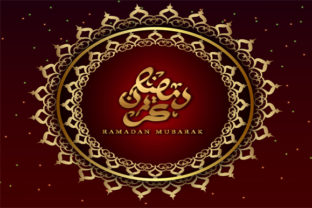
Ramadan Mubarak Greeting Ornament Pattern
At its heart, a Ramadan Mubarak Greeting Ornament Pattern is a carefully composed visual framework—often in vector format—that blends traditional Islamic design language with festive symbolism. Think interlacing arabesque lines, crescent moons and stars, stylized lanterns (fanous), subtle mosque silhouettes, and elegant Arabic calligraphy for “Ramadan Mubarak” or “Ramadan Kareem.” These patterns aren’t just decorative; they’re cultural anchors—rooted in centuries of Islamic art, yet flexible enough for modern digital use.
Why This Matters—Depending on Who You Are
For a freelance graphic designer, this pattern might be the starting point for a client’s Eid campaign—saving hours on custom illustration while ensuring cultural authenticity. A small business owner running a halal bakery or modest fashion boutique may use it to refresh social media banners, printable gift tags, or limited-edition packaging—adding warmth and intention without hiring a specialist. Meanwhile, an educator preparing a unit on world religions could project a high-resolution version during a lesson on Ramadan traditions, using its motifs to spark discussion about symbolism, geometry in Islamic art, and the meaning behind light, night, and renewal.
A hobbyist creating handmade cards might download a printable PDF version to cut, layer, and embellish with gold foil or watercolor—valuing clarity, scalability, and clean line work over complex gradients. In contrast, a marketing manager at a multicultural nonprofit may prioritize editable vector files (AI or SVG) that integrate smoothly into Canva templates or CMS platforms—so their team can quickly adapt the same base pattern across email headers, donation page backgrounds, and virtual event signage.
What to Look For—Beyond Aesthetics
Not all ornament patterns serve the same purpose—even if they look similar at first glance. Here’s how priorities shift:
- Ease of use: Beginners benefit from ZIP packages with layered PSD files, clear naming conventions (“lantern-only,” “calligraphy-overlay”), and usage guides. A single ungrouped SVG may frustrate someone unfamiliar with vector editing.
- Flexibility: Designers and developers need transparent backgrounds, CMYK + RGB color variants, and scalable vectors—not raster JPGs that pixelate when enlarged for posters or murals.
- Cultural resonance: Educators and community organizers pay close attention to motif accuracy—e.g., avoiding figural representation where inappropriate, ensuring Arabic script flows correctly (right-to-left, properly connected letters), and honoring regional variations (Ottoman-inspired flourishes vs. Gulf-style minimalism).
- Commercial safety: Entrepreneurs and publishers verify licensing terms—especially whether the pattern permits resale on physical products (like mugs or fabric) or digital redistribution (as part of a design bundle).
- Presentation quality: A mosque-themed banner for a community center’s website needs crisp anti-aliased edges and balanced negative space—not dense, overwhelming detail that blurs on mobile screens.
Real Uses—Across Skill Levels
A beginner blogger might use a pre-sized Instagram Story template (1080×1920 px) featuring a soft blue-and-gold ornament pattern as a background for a “30 Days of Ramadan Reflections” series—simply adding text overlays in Canva. No design software required. The pattern does the heavy lifting: evoking reverence, tradition, and celebration in one glance.
An experienced illustrator may import the vector pattern as a reference layer, then reinterpret its core elements—redrawing the lantern with hand-drawn texture, adapting the arabesque into a seamless tile for textile printing, or animating the crescent moon’s glow in After Effects. Here, the pattern isn’t the final product—it’s inspiration with integrity.
A small mosque committee planning Eid celebrations could repurpose the same pattern across multiple touchpoints: a simplified version for children’s coloring sheets (bold outlines, no fine details), a richly detailed variant for the prayer hall’s welcome banner, and a monochrome adaptation for engraved wooden name tags at the iftar table. Consistency builds recognition; adaptability meets real-world constraints.
Choosing What Fits Your Project
Ask yourself: Is this for personal expression, community outreach, or commercial production? If you’re designing a one-time classroom handout, a free, well-structured PNG with transparent background may be perfect. If you’re building a brand identity system for a Muslim wellness app, invest in a premium vector pack with alternate color palettes (midnight indigo, desert rose, olive-and-cream), modular components (separate star, lantern, and calligraphy layers), and documentation on symbolic meanings.
Also consider context. A pattern heavy with ornate Ottoman motifs may feel deeply meaningful for a Turkish cultural association—but less resonant for a Southeast Asian Muslim audience more familiar with Malay woodcarving or Javanese batik influences. Look for collections that acknowledge diversity within the global Ummah—not just “Islamic” as a monolith, but as a living, regional, evolving visual language.
Where It Lives—and Why That Matters
You’ll find Ramadan Mubarak Greeting Ornament Patterns used everywhere: as website backgrounds that softly reinforce seasonal intention without distracting from content; as email newsletter dividers between sections on fasting tips and charity ideas; as printable wall art for home decor during the holy month; even as embroidery guides for DIY cushion covers or prayer rug borders. Their strength lies in quiet versatility—not shouting, but grounding.
Unlike photorealistic illustrations or stock photos, these patterns carry weight through abstraction and repetition: the infinite loop of the arabesque mirrors tawhid (Oneness of God); the crescent and star evoke both lunar observation and celestial guidance; the lantern speaks to inner light, knowledge, and shared warmth during long nights of worship.
So whether you're choosing a pattern for a student’s art project, a startup’s Ramadan campaign, or your own quiet moment of reflection—what matters most isn’t complexity or trendiness. It’s whether the design holds space for meaning, respects tradition, and leaves room for your voice to join the conversation.